Cart
0
The Promise vs. the Reality
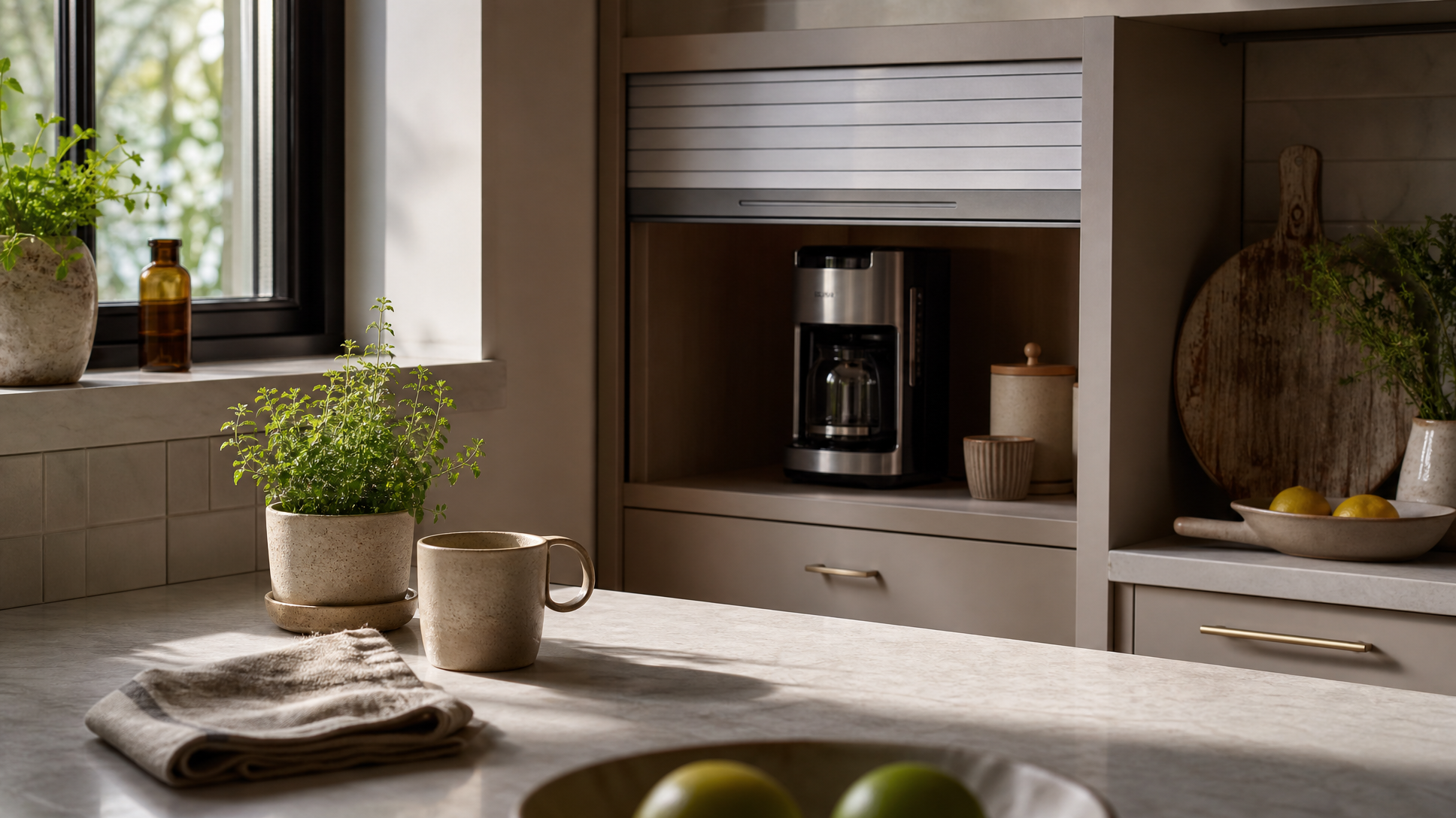
You've seen the Pinterest kitchens: a tambour door rolls up, a coffee maker appears, and the counter is otherwise spotless. Appliance garages look like the answer to every cluttered kitchen problem. But talk to anyone who's actually lived with one for a few years, and the story gets more complicated.
Before you carve out cabinet space, spend money on custom millwork, or reorganize your entire upper-cabinet layout, it's worth understanding what an appliance garage actually does well — and where it quietly fails you.
What Is an Appliance Garage, Exactly?
An appliance garage is a dedicated cabinet section — typically built into the corner of a kitchen counter or along the backsplash — designed to hide small appliances like toasters, stand mixers, coffee makers, and air fryers behind a door. The door is usually a roll-up tambour style (think of an old rolltop desk), though swing-out and lift-up versions exist too.
The idea is simple: appliances stay plugged in and accessible, but hidden when you're not using them. Clean counter, zero effort.
The Case For One
An appliance garage genuinely earns its keep in a few specific situations.
You use the same appliances every single day. If your coffee maker runs every morning and your toaster runs every afternoon, you don't want to haul them out of a deep lower cabinet twice a day. An appliance garage lets them stay plugged in and ready without sitting on your counter 24/7.
You have the counter depth to spare. A proper appliance garage needs enough depth to fit the appliance with the door closed — most standard counters are around 24 to 25 inches deep, and a tall appliance like a stand mixer will need every inch of that. If your kitchen is already tight, the math may not work.
You're doing a full kitchen renovation anyway. Adding an appliance garage mid-renovation costs far less than retrofitting one later. If the walls are already open and the cabinets are being built to spec, it's a reasonable line item.
The Case Against One
Here's where the honest part comes in — and why a lot of homeowners end up regretting the decision.
Appliance garages eat cabinet storage. That section of upper cabinet you're converting? It's now permanently dedicated to appliances. If your kitchen is short on storage to begin with, trading a general-purpose cabinet for a single-purpose garage is a real sacrifice.
The door breaks or becomes annoying. Tambour doors are the classic choice, but they're also one of the most common kitchen repair complaints. The slats can warp, stick, or come off their track — and replacement parts aren't always easy to find for older kitchens.
Appliances change; built-ins don't. You might buy a new air fryer that's two inches taller than the old one. Or switch coffee makers. A fixed cabinet opening doesn't adapt with you, and suddenly the garage doesn't fit what you actually own.
It can look dated. The appliance garage had its heyday in the 1990s and early 2000s. In some kitchen styles — particularly modern, open, or minimalist designs — a tambour-door cabinet section can feel out of place. That said, in a traditional or transitional kitchen, it still looks perfectly at home. Context matters.
Is It Outdated or Still Smart?
Neither, really. An appliance garage is a tool, not a trend. It works brilliantly in the right kitchen and falls flat in the wrong one. The question isn't whether appliance garages are in or out — it's whether your specific kitchen layout, your appliance habits, and your renovation budget make one a sensible investment.
If you're remodeling a traditional kitchen with ample counter depth, you use the same two or three appliances daily, and you have a good cabinet maker, it's a smart move. If you're renting, working with a galley kitchen, or just want a tidier counter without a construction project, there are faster paths to the same result.
What to Do Instead (Without the Renovation)
The real goal of an appliance garage is a clear counter — and you can get most of the way there without touching a single cabinet.
Designate a dedicated appliance zone. Pick one section of counter as the only place appliances live. Everything else is off-limits. The visual discipline alone makes a kitchen feel more organized.
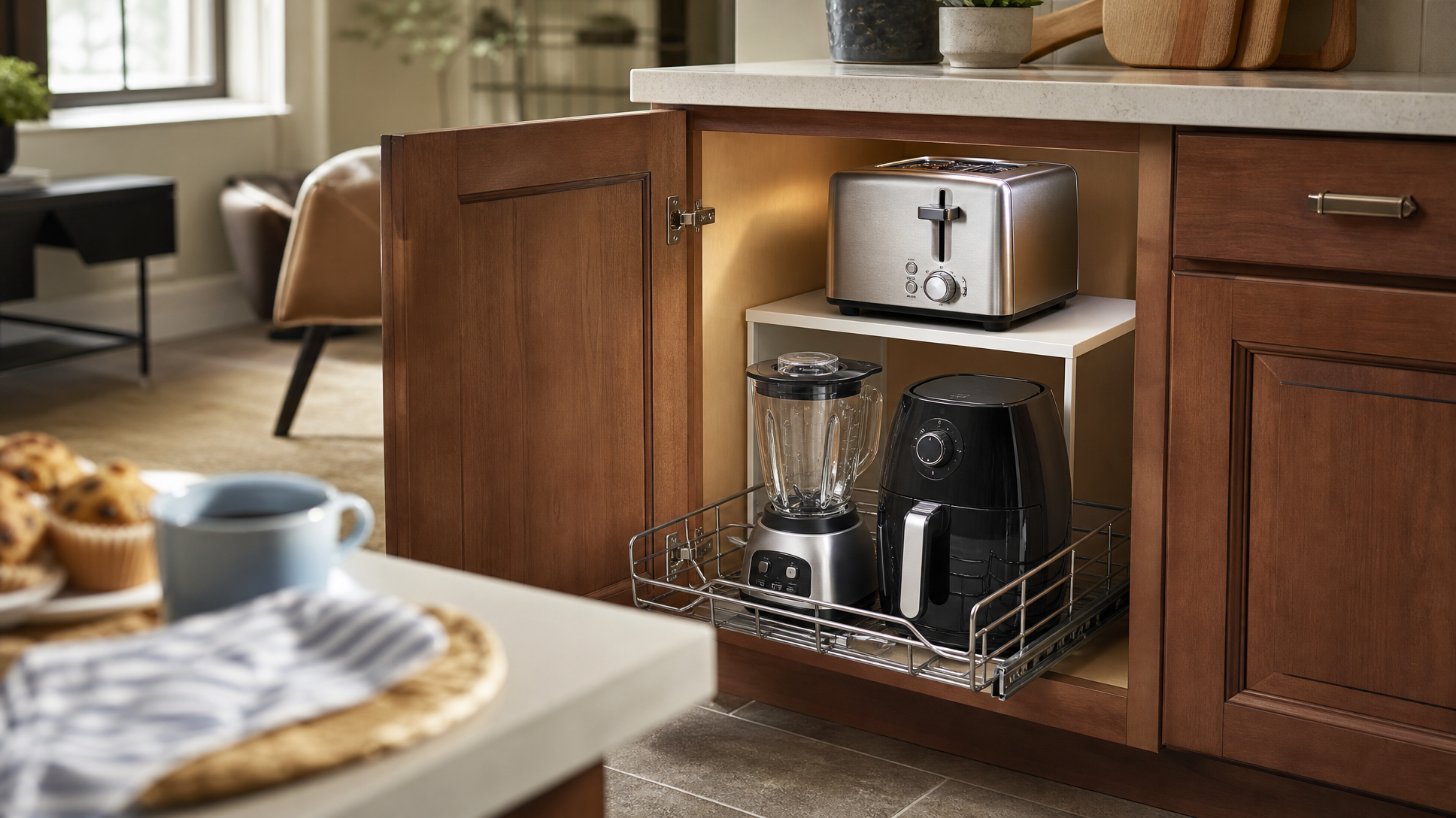
Move rarely-used appliances off the counter entirely. That bread maker you use twice a year doesn't need prime counter real estate. A lower cabinet with a pull-out shelf, or a pantry shelf, works just as well for appliances you don't reach for daily.
Use open shelving or a rolling cart. Some kitchens benefit from a small utility cart or a dedicated shelf where appliances live openly but intentionally — it's organized, not cluttered, and it's flexible.
Invest in smart storage solutions. Stackable cabinet organizers, shelf risers, and wire baskets can transform a deep lower cabinet into a genuinely usable appliance storage zone — one that actually adapts when your appliances change. Explore the appliances collection if you're also in the market for compact, counter-friendly options that take up less space to begin with.
If you're also thinking through the bigger picture of outfitting a kitchen or newly moved-in home, the practical new-home checklist covers what actually matters room by room — worth a read before you start spending on built-ins.
The Bottom Line
An appliance garage isn't a must-have or a mistake — it's a specific solution to a specific problem. If your kitchen layout, budget, and habits align with what it does well, it's a genuinely smart upgrade. If they don't, you'll get a cleaner counter faster and cheaper by rethinking how you store and rotate what's already there.
Not ready to build one? Browse the full home organization lineup — stackable wire baskets, cabinet organizers, and shelf risers can create the same clear-counter effect without touching a single wall.
Frequently Asked Questions
How deep does a counter need to be for an appliance garage?
Most standard kitchen counters run around 24 to 25 inches deep, which is enough for many common appliances — but just barely for taller ones like stand mixers. Before committing to a built-in garage, measure your tallest appliance with the lid or head fully raised, and confirm it fits within your counter depth with the door closed. Depth is the constraint that catches most people off guard.
Can you add an appliance garage to an existing kitchen without a full renovation?
It's possible but not simple. Retrofitting an appliance garage into existing cabinetry usually requires a carpenter to modify or replace an upper cabinet section, add electrical inside the cabinet, and install a door mechanism. It's less disruptive than a full kitchen remodel, but it's still a real construction job — not a weekend DIY project for most people. If budget is a concern, counter organization systems will get you most of the visual benefit without the build.
Are tambour doors on appliance garages hard to maintain?
They can be. Tambour doors — the roll-up style most commonly used — have individual slats that can warp, stick, or jump off their tracks over time, especially in kitchens with humidity fluctuations. Swing-out or lift-up door options tend to be more mechanically reliable, though they require clearance space to open. If you're building one, ask your cabinet maker about door hardware quality and what the repair process looks like before committing to a style.
What appliances actually work well in an appliance garage?
The best candidates are appliances you use daily or near-daily and that stay plugged in — coffee makers, toasters, and electric kettles are the classic examples. Appliances you only pull out occasionally (blenders, stand mixers, air fryers) are often better stored in a lower cabinet, since the whole point of a garage is convenient access, not just hiding things. An appliance garage filled with things you rarely use is just an expensive, hard-to-access cabinet.