Cart
0
You've probably seen the headlines. "Nonstick pans are toxic." "Switch to ceramic." "Actually, ceramic isn't ceramic." It's enough to make you want to just boil water in a stainless steel pot and call it a day. But if you're replacing a scratched-up saucepan or buying your first proper set, you deserve a straight answer — not more noise.
Let's cut through it.
What People Actually Mean by "Nonstick"
Traditional nonstick cookware uses a synthetic polymer coating — the most common being PTFE (sold under brand names like Teflon). It works brilliantly until it doesn't: overheat it, scratch it, or let it age past its prime, and the coating can degrade. That's where the safety concerns come from, and they're not entirely unfounded.
PFOA — a chemical once used in the manufacturing of PTFE coatings — was the bigger villain. It's a persistent environmental contaminant linked to health concerns, and reputable manufacturers phased it out years ago. But the association stuck, and "nonstick" became a dirty word for a lot of health-conscious cooks.
Ceramic nonstick entered the conversation as an alternative. And here's where the confusion starts.
"Ceramic" Doesn't Mean What You Think It Does
Ceramic nonstick pans aren't made of ceramic the way a mug or tile is. The coating is a silica-based (sand-derived) layer applied to a metal core — usually aluminum. It's smooth, hard, and naturally slick, which is why food releases easily. The "ceramic" name refers to the mineral origin of the coating material, not the construction of the pan itself.
What makes it different from traditional PTFE nonstick is what it doesn't contain. A quality ceramic nonstick coating is free from PTFE, PFOA, and the broader family of PFAS chemicals (sometimes called "forever chemicals"), as well as heavy metals like lead and cadmium. That's the actual safety story — not that ceramic is magic, but that it sidesteps the chemical concerns that made older coatings controversial.
So Is It Safe? The Honest Answer
For everyday cooking at normal temperatures, yes — ceramic nonstick is widely considered a safer alternative to older PTFE-based coatings, precisely because it avoids the chemicals that raised flags in the first place. It doesn't off-gas at high heat the way PTFE can, and a coating that's free from PFAS, PFOA, lead, and cadmium removes the main concerns health-conscious cooks have.
That said, no nonstick coating is indestructible. The real safety question isn't just "what's in the coating" — it's "what happens when it wears out?" Which brings us to the part most buying guides skip.
How You Treat It Matters More Than the Label
Ceramic nonstick coatings are hard — noticeably harder than traditional PTFE — but they're not immune to damage. The things that shorten their life are predictable and avoidable:
- Metal utensils. Use wood, silicone, or nylon. Metal will scratch any nonstick surface over time.
- Stacking pans without protection. Tossing a lid or another pan on top chips the coating. A folded dish towel between pans is enough.
- Thermal shock. Don't run a hot pan under cold water. Let it cool before washing.
- Dishwashers. Even "dishwasher-safe" nonstick degrades faster with repeated machine washing. Hand-wash with warm soapy water and a soft cloth.
- Cooking spray. Aerosol cooking sprays leave a sticky residue that builds up on ceramic surfaces and reduces nonstick performance. Use a small amount of butter or oil instead.
Treat the coating well, and it lasts. Ignore these basics, and you'll be replacing the pan long before you should.
The "Nonstick vs. Ceramic" Comparison Gets It Wrong
A lot of comparison articles frame this as PTFE nonstick versus ceramic nonstick, as if they're completely different categories of cookware. They're not. Both are nonstick coatings applied to a metal pan — the difference is the coating chemistry. Ceramic is the newer, cleaner option. PTFE is the older, more established one.
What actually matters when you're comparing pans is the quality of the base metal, the thickness of the coating, and whether the manufacturer is transparent about what's in it. A cheap ceramic pan with a thin coating on a flimsy base will disappoint you faster than a well-made PTFE pan from a reputable brand — and vice versa. The coating type is one factor, not the whole story.
What to Look For When You're Actually Buying
If you're shopping for a ceramic nonstick saucepan or set, here's what's worth checking:
- Coating transparency. Look for explicit confirmation that the coating is free from PFAS, PFOA, PTFE, lead, and cadmium. Vague claims like "eco-friendly" or "green coating" aren't enough.
- Core material. Cast aluminum distributes heat evenly and resists warping better than thin-gauge aluminum. Uneven heating is the enemy of nonstick performance — hot spots cause food to stick and coatings to wear unevenly.
- Base compatibility. If you have an induction stovetop, make sure the pan has a magnetic stainless steel base. Not all ceramic nonstick pans are induction-compatible.
- Handle design. Handles that stay cool on the stovetop aren't a luxury — they're a basic safety feature. Bakelite and certain composite handles do this well.
- Interior rivets. Rivets holding the handle to the pan create crevices where food and bacteria collect. A rivet-free interior is genuinely easier to keep clean.
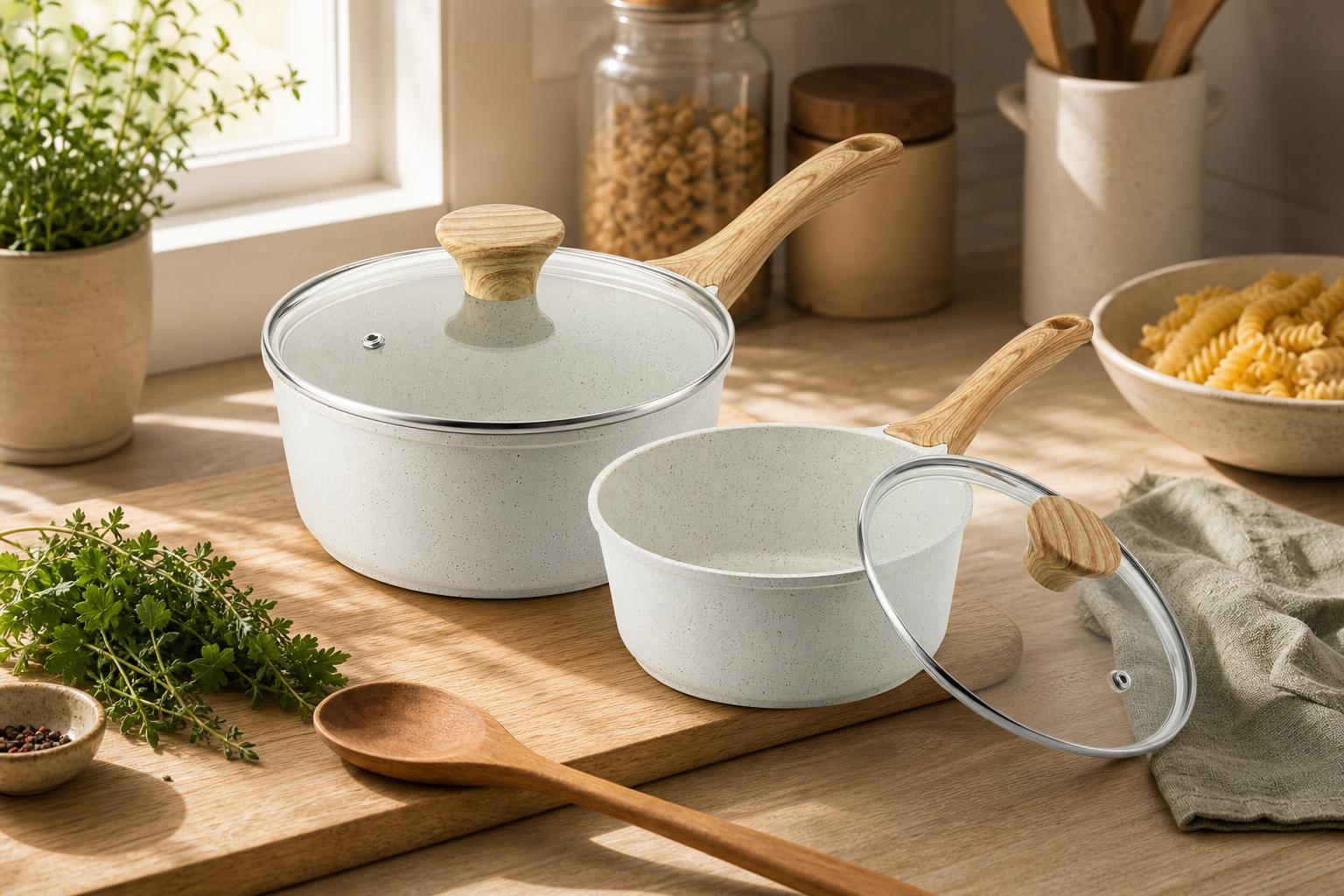
The Sensarte White Ceramic Nonstick Saucepan set available at Homenkitchenshop ticks all of these boxes: the coating is explicitly PFOA, PTFE, PFAS, lead, and cadmium-free; the cast aluminum core heats evenly; the stainless steel base works on all stovetops including induction; the woodgrain bakelite handles stay cool; and the rivet-free interior makes cleanup genuinely effortless. It's a useful reference point for what a well-specified ceramic nonstick pan looks like in practice.
If you're in the middle of setting up a kitchen for the first time, the practical new-home checklist is worth a read alongside this — cookware decisions don't exist in a vacuum when you're outfitting a whole kitchen from scratch.
The Short Version
Ceramic nonstick cookware is a legitimate, cleaner alternative to older PTFE-based coatings — not because of hype, but because it avoids the specific chemicals that made traditional nonstick controversial. Whether it's right for you comes down to how you cook, how you care for your pans, and whether the specific product you're buying is made well enough to back up its claims.
Buy something with a transparent ingredient list, a solid aluminum core, and handles that won't burn you. Treat it right. It'll earn its place on your stovetop.
Ready to upgrade? Shop ceramic nonstick cookware at Homenkitchenshop.com and find a set that actually fits how you cook.
Frequently Asked Questions
Is ceramic nonstick cookware free from PFAS and PFOA?
A quality ceramic nonstick coating is manufactured without PFAS, PFOA, PTFE, lead, or cadmium — that's the core reason many cooks prefer it over older nonstick options. Always check the product listing for explicit confirmation of this rather than relying on vague "eco-friendly" language.
Does ceramic nonstick work on induction stovetops?
Not automatically. Ceramic nonstick refers to the coating, not the base. For induction compatibility, the pan needs a magnetic stainless steel base. Always confirm induction compatibility before buying — it will be listed in the product specifications if it applies.
How do I make a ceramic nonstick pan last longer?
The biggest factors are utensils and washing. Use silicone, wood, or nylon utensils — never metal. Hand-wash with warm soapy water and a soft cloth rather than using the dishwasher, and avoid aerosol cooking sprays, which leave a residue that degrades the surface over time. Let the pan cool before washing to avoid thermal shock.
When should I replace a ceramic nonstick pan?
When food starts sticking consistently even on a clean, lightly oiled surface, or if you notice visible chips or flaking in the coating, it's time to replace it. A well-maintained ceramic nonstick pan should last considerably longer than a poorly treated one — care makes a bigger difference than the brand name.