Cart
0
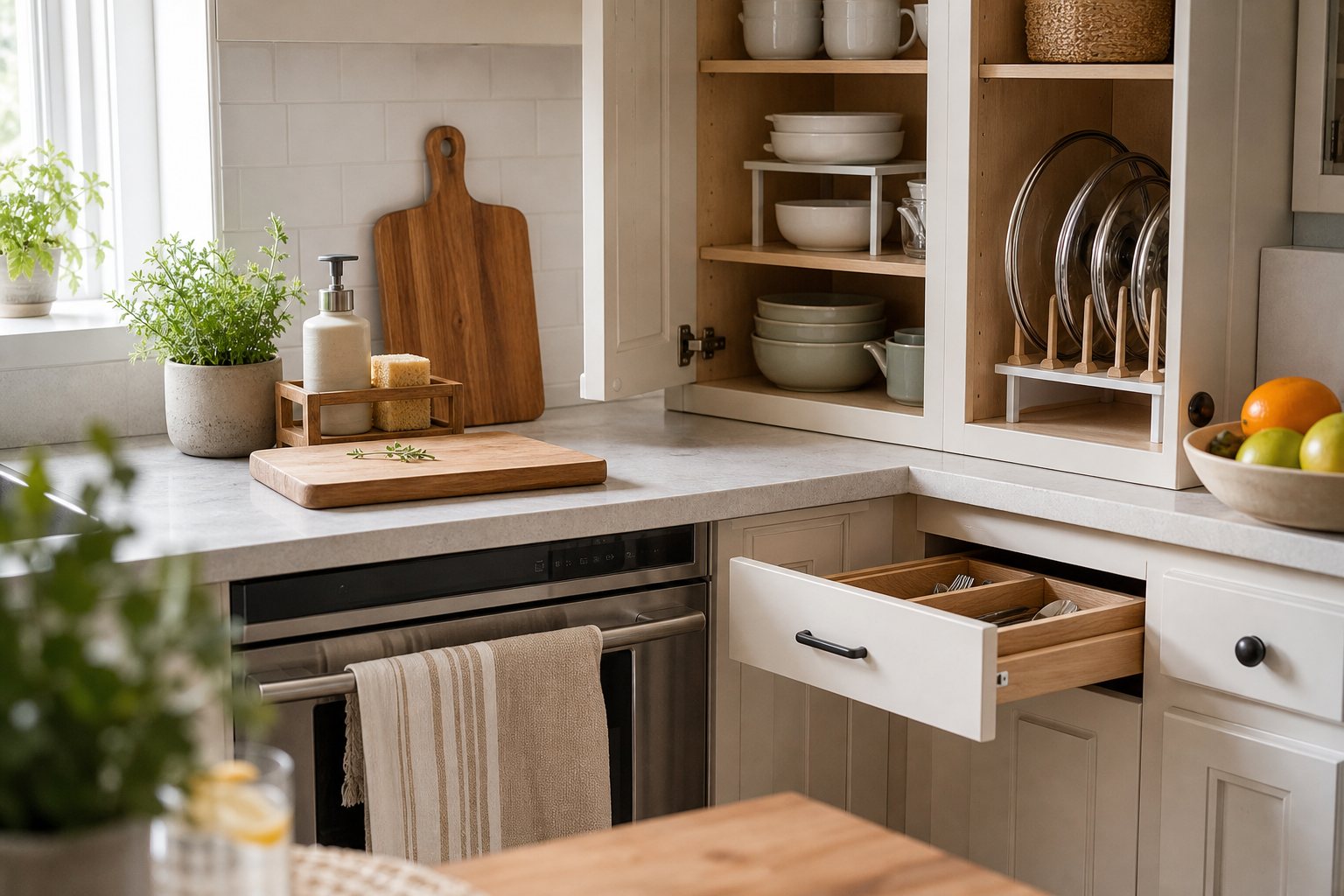
The people with the messiest kitchens are often the ones who use them the most. If you actually cook — weeknight dinners, weekend batch prep, the occasional ambitious recipe that takes over the whole counter — clutter isn't a personality flaw. It's a layout problem.
The fix isn't a full renovation or a minimalist lifestyle overhaul. It's identifying the two or three spots where friction builds up and solving those specifically. Once those are sorted, the whole kitchen exhales.
Here's where to look.
The Counter: Your Most Valuable Real Estate
The kitchen counter is where everything lands and nothing leaves. The toaster you use twice a week, the olive oil you use twice a day, the mail that somehow migrated from the front door — it all ends up here.
The honest rule: anything that doesn't get used at least a few times a week shouldn't live on the counter. That's not about being precious with your space — it's about keeping your prep area functional. When you're chopping vegetables and you have to shuffle three things out of the way first, you've already lost the battle.
Start by pulling everything off and putting back only what earns its spot. The things that don't make the cut need a home somewhere else — a lower cabinet, a pantry shelf, a drawer. If they don't have one, that's the real problem to solve.
The Cabinet Door: The Overlooked Inch of Storage
Most people treat cabinet doors as the front of a box. They're actually storage space. The inside of a cabinet door — especially under the sink or next to the stove — can hold cutting boards, lids, cleaning supplies, foil and wrap boxes, even spice jars with the right organizer.
This is one of the highest-return fixes in a kitchen because it takes something you already have (door space) and turns it into a functional slot for things that currently float around your counters or get buried at the back of shelves.
Over-the-door and inside-cabinet organizers require no drilling in most cases and take about ten minutes to install. The payoff is disproportionate to the effort.
The Junk Drawer: Stop Trying to Eliminate It
Every kitchen has a junk drawer. The goal isn't to get rid of it — that's a fantasy. The goal is to make it a contained junk drawer so it doesn't metastasize into three junk drawers.
A simple drawer divider or a set of small bins turns a chaotic pile into a system. Batteries in one slot, takeout menus in another, the scissors that everyone pretends they can't find. When the drawer has structure, it stays manageable because things have a place to return to.
The junk drawer earns its keep. Just give it boundaries.
The Sink Area: Where Clutter Hides in Plain Sight
Dish soap, sponges, scrubbers, a strainer, maybe a second sponge you forgot about — the sink area accumulates a surprising amount of small items that create visual noise even when they're technically where they belong.
A sink strainer that fits properly (and doesn't require you to fish debris out with your fingers) removes one daily annoyance. A small caddy or tray corrals the soaps and sponges into a defined zone rather than letting them spread across the counter edge. These are small fixes, but they're the kind you notice every single time you do the dishes.
The Cabinet Interior: The Avalanche Problem
You open the cabinet, something falls out, you shove it back in and close the door faster. This is not a storage system — it's a delay tactic.
Pots, pans, lids, and baking sheets are the worst offenders because they're large, irregularly shaped, and don't stack neatly. A few targeted organizers — a vertical lid rack, a shelf riser, a pull-out bin — can turn a cabinet that functions like a game of Jenga into one you can actually navigate mid-recipe.
The same logic applies to pantry shelves. If you can't see what's at the back, you'll buy duplicates of things you already have and run out of things you thought you had. Clear bins, turntables, and shelf risers make the back of a shelf as accessible as the front.
The "Landing Zone" Problem
Most kitchen clutter doesn't start in the kitchen. It starts at the door, migrates to the counter, and settles in. Bags, keys, mail, chargers — they land in the kitchen because the kitchen is where people actually spend time.
If this is your kitchen, the fix is giving these items a home before they reach the counter. A small hook or tray near the entry point of your home intercepts the clutter before it travels. This sounds obvious, but it's one of the most effective interventions because it addresses the problem at its source rather than managing the symptoms.
For anyone setting up a home from scratch or doing a bigger reset, this practical new-home checklist covers the organizational groundwork that makes every room — not just the kitchen — easier to maintain from day one.
The One-In-One-Out Rule (That Actually Works)
Organization isn't a one-time project. Kitchens fill back up because we keep acquiring things — gadgets, appliances, duplicates of spatulas we already own. The simplest maintenance system: when something new comes in, something old goes out.
This isn't about deprivation. It's about keeping the physical space matched to the storage capacity you actually have. A kitchen that's organized for its current contents stays organized. One that's perpetually over-capacity never will be, no matter how many bins you buy.
The clutter-free kitchen isn't a different kind of kitchen from yours. It's the same kitchen, with the friction points identified and solved one by one.
Find the storage and organization tools that actually fit your kitchen workflow at Homenkitchenshop — from drawer dividers and cabinet organizers to sink accessories and pantry solutions, all in one place.
Frequently Asked Questions
Where should I start if my entire kitchen feels disorganized?
Start with the counter. It's the highest-traffic surface and the one that affects how the whole kitchen feels. Clear it completely, then only return what you use multiple times a week. Once the counter is under control, move to whichever spot causes you the most daily frustration — usually the junk drawer or the cabinet where things fall out.
Do I need to buy a lot of organizers to make a real difference?
Not at all. A few well-chosen pieces — a drawer divider, a lid rack, a small caddy for the sink area — tend to have an outsized impact because they solve specific friction points rather than just adding more containers. Buying organizers before you know where the real problem is often just relocates the clutter.
How do I stop the kitchen from getting cluttered again after I organize it?
The most reliable habit is the one-in-one-out rule: when a new item enters the kitchen, an old one leaves. Beyond that, making sure everything has a specific home — not just a general "drawer" but a specific slot — makes it easier to return things after use. When putting something away takes more effort than leaving it on the counter, the counter always wins.
What's the best way to organize a small kitchen with limited cabinet space?
Use vertical space and door space aggressively. The inside of cabinet doors, the walls above counters, and the space under shelves are all underused in most small kitchens. Hanging organizers, magnetic strips, and over-door racks can effectively double your usable storage without requiring any permanent changes — which matters especially if you're renting.