Cart
0
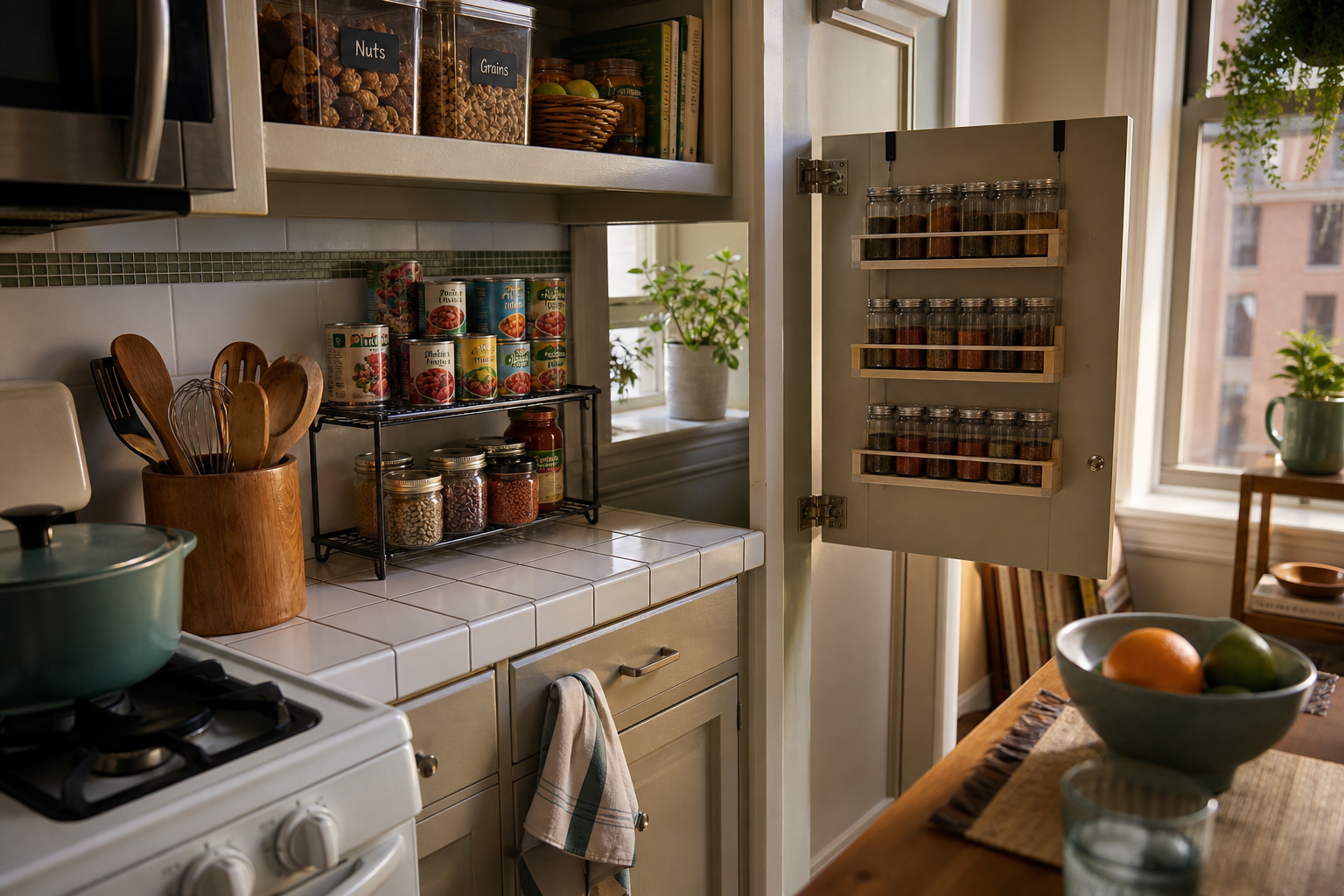
The real problem isn't that your kitchen is too small
It's that every inch is doing the wrong job. The counter is buried under appliances that rarely get used. The cabinet doors are completely bare. The single junk drawer has somehow swallowed three spatulas, a rubber band, and a mystery key. And the pantry shelf? One tall cereal box is holding everything hostage.
Most small-kitchen storage advice tells you to "declutter first" and then shows you a pristine kitchen that clearly belongs to someone with no food. This guide skips that. Instead, it takes your kitchen zone by zone — counter, cabinet door, drawer, pantry shelf — and gives you a concrete fix for each one, without asking you to get rid of the things you actually use.
Zone 1: The Counter (Stop Treating It Like a Parking Lot)
Counter space is prime real estate, and most of us are squandering it on things that only come out twice a month. The fix isn't to clear everything off — it's to be ruthless about what earns a permanent spot.
Anything you use daily (coffee maker, toaster, knife block) can stay. Everything else needs a home elsewhere. The mistake people make is keeping the blender, the air fryer, the stand mixer, and the fruit bowl all out at once, then wondering why there's no room to actually chop a vegetable.
Once you've moved the occasional-use appliances to a lower cabinet or a shelf, use what's left of your counter intentionally. A small tiered rack or a corner shelf unit can double your vertical space without eating more counter footprint — you're stacking up instead of spreading out. A small dish rack that drains directly into the sink also frees up the area next to it faster than you'd think.
Zone 2: The Cabinet Door (The Most Wasted Space in Any Kitchen)
Open any cabinet in a small kitchen and look at the inside of the door. Probably nothing there, right? That flat surface is one of the most consistently wasted spaces in home kitchens, and it's fixable with almost no effort.
Over-the-door organizers — the kind with wire pockets or small shelves — can hold spice jars, cleaning supplies, pot lids, aluminum foil and plastic wrap boxes, or even a small cutting board. The inside of the cabinet under the sink is especially useful for this: a door-mounted organizer there can hold dish soap, sponges, and scrubbers so they're not cluttering up the sink edge.
Adhesive hooks on the inside of cabinet doors are another underused trick. A few small hooks can hold measuring cups, a colander, or oven mitts — things that are always getting buried in a drawer somewhere.
Zone 3: The Drawer (One Drawer Does Not Have to Do Everything)
The universal kitchen drawer problem: you have one drawer that's become a catch-all, and three others that are oddly empty or holding things that don't belong there. The solution is to actually assign jobs to each drawer, then use dividers to enforce them.
A dedicated utensil drawer with a proper divider tray keeps spatulas, tongs, and wooden spoons from tangling into a nest every time you open it. A second drawer for wraps, bags, and foil — organized with a small tension rod or a box insert — means you're not digging through a drawer of chaos every time you need to cover a bowl.
For the junk drawer situation: give it a structure rather than trying to eliminate it. A set of small drawer organizer bins turns a chaotic junk drawer into a functional one. One bin for batteries, one for twist ties and rubber bands, one for the random tools that don't belong anywhere else. It's still a junk drawer — it just works now.
If you're genuinely short on drawer space, a countertop utensil crock for your most-used cooking tools is a practical trade-off. It takes up a small footprint and keeps your main drawer from becoming a utensil graveyard.
Zone 4: The Pantry Shelf (Height Is the Problem, Stacking Is the Fix)
Standard pantry shelves are spaced far apart to accommodate tall boxes — which means the space above a can of beans and below the next shelf is just dead air. You're using maybe half the actual volume you have.
Shelf risers and stackable bins solve this immediately. A two-tier shelf riser inside a pantry shelf lets you see what's in the back row without moving the front row. Stackable clear bins let you group categories — snacks, baking supplies, canned goods — so you're not excavating the shelf every time you need something specific.
For a deep pantry shelf, the rule is: front row for what you use this week, back row for backup stock. If you can't see it, you'll forget it exists and buy a third jar of peanut butter. Labeling the bins, even just with a piece of tape and a marker, makes the system stick.
Wire pull-out baskets that slide on a shelf are worth considering if you have the budget — they let you reach items at the back without unpacking the front, which is the main reason pantry shelves devolve into chaos over time.
The one rule that holds all four zones together
Every item in your kitchen should have one assigned home, and that home should be as close as possible to where you actually use it. Spices go near the stove. Mugs go near the coffee maker. Baking supplies go together, even if they're spread across a drawer and a pantry bin.
When everything has a place, putting it back becomes automatic. That's when a small kitchen stops feeling chaotic — not when you've bought more storage, but when the storage you have is actually organized around how you cook.
If you're starting from scratch or moving into a new place, the practical new-home checklist beyond the kitchen is a useful companion to this guide — it covers what to prioritize buying when you're setting up a whole home, not just the kitchen.
Find the storage tools that fit your kitchen at Homenkitchenshop — from drawer dividers to wire baskets and shelf risers, it's all in one place.
Frequently Asked Questions
What's the best storage solution for a kitchen with almost no cabinet space at all?
When cabinets are truly minimal, the goal is to go vertical and use every overlooked surface. A freestanding shelving unit or a rolling kitchen cart can add significant storage without any installation. Over-the-door organizers, wall-mounted magnetic strips for knives, and tension rod dividers inside what cabinet space you do have all help stretch a tight situation further.
How do I keep a small kitchen organized when I have a lot of cooking equipment?
The key is honest frequency sorting: separate what you use every week from what you use a few times a year. Daily and weekly items get the best real estate — accessible drawers, front-of-shelf spots, counter space. Seasonal or occasional equipment (a big roasting pan, a specialty appliance) can live in harder-to-reach spots like a high shelf or even a storage closet, as long as you can get to it when you need it.
Are there renter-friendly storage options that don't require drilling or permanent changes?
Yes — most of the best small-kitchen storage solutions are renter-friendly by design. Over-the-door organizers hang without tools. Tension rods need no hardware. Stackable bins and shelf risers sit freely on existing shelves. Adhesive hooks (the removable kind rated for smooth surfaces) can handle light loads on cabinet interiors without leaving damage. You can build a well-organized kitchen without touching a single wall.
How do I stop my pantry from becoming disorganized again after I sort it?
Systems fall apart when putting something back is harder than just setting it down anywhere. The fix is to make the organized state the path of least resistance: use open bins (no lids to remove), label everything clearly, and keep categories consistent. A quick five-minute reset once a week — before grocery shopping, when you can see what's actually low — is enough to keep a pantry functional long-term.